
- 💊 Buy Gabapentin Online
- 💊 Buy Butalbital Online
- 💊 Buy Tramadol Online
- 💊 Buy Xanax Online
- 💊 Buy Ambien Online
- 💊 Buy Carisoprodol Online
- 💊 Buy Hydrocodone Online
- 💊 Buy Alprazolam Online
- 💊 Buy Cialis Online
- 💊 Buy Clonazepam Online
- 💊 Buy Diazepam Online
- 💊 Buy Flexeril Online
- 💊 Buy Levitra Online
- 💊 Buy Lexapro Online
- 💊 Buy Lorazepam Ativan Online
- 💊 Buy Methadone Online
- 💊 Buy Viagra Online
- 💊 Buy Valium Online
- 💊 Buy Tapentadol Online
- 💊 Buy Neurontin Online
- 💊 Buy Adderall Online
Sleep Effort: Why Trying Harder to Fall Asleep Can Keep You Awake
- Home
- /
- Blog
- /
- Sleep Effort: Why Trying Harder to Fall Asleep Can Keep You Awake
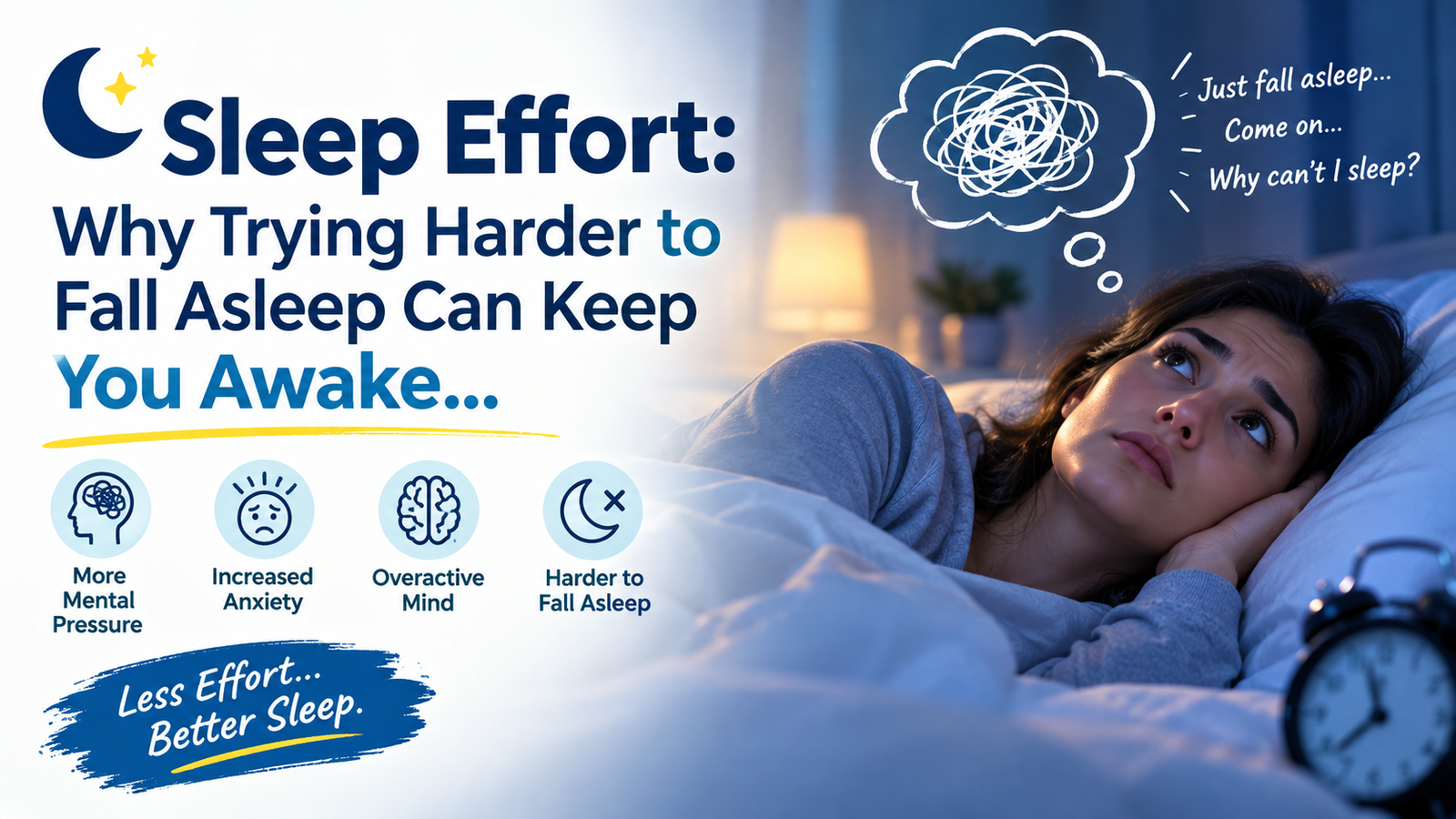
Have you ever gone to bed feeling completely exhausted, only to become more alert the harder you try to fall asleep? You close your eyes, adjust your pillow, check the clock, and tell yourself that you need to sleep immediately. Yet, instead of drifting off, your thoughts become louder and your frustration grows.
This experience is often described as sleep effort—the mental pressure we put on ourselves to make sleep happen. Although wanting a restful night is natural, treating sleep like a task that must be completed can increase alertness and make bedtime more stressful.
Sleep is not something you can force simply through willpower. You can establish habits that support it, but excessive monitoring, worrying about tomorrow, and repeatedly checking whether you are asleep can work against that goal.
In this guide, we'll explore why sleep effort develops, how it can contribute to insomnia, and practical ways to break the cycle. For additional health-related information, visit JustinMedz.
What Is Sleep Effort?
Sleep effort refers to the mental and behavioral attempts people make to control when and how quickly they fall asleep. It can include watching the clock, counting the hours remaining before an alarm, trying to suppress every thought, or repeatedly checking whether the body feels relaxed enough for sleep.
You might recognize thoughts such as:
"I have to fall asleep right now."
"If I don't sleep, tomorrow will be a disaster."
"Why am I still awake when I'm so tired?"
"I need to stop thinking and relax."
"I must get eight hours of sleep tonight."
These reactions are understandable, especially after several nights of poor sleep. However, they can turn bedtime into a performance test rather than an opportunity to rest.
The National Heart, Lung, and Blood Institute explains that worrying about sleep and watching the clock can contribute to insomnia. Its guide to insomnia causes provides further information about factors that can interfere with healthy sleep.
Sleep effort is not a diagnosis by itself. Occasional difficulty falling asleep is common, but repeatedly feeling anxious or frustrated at bedtime may reinforce an existing sleep problem.
Why Trying Harder to Sleep Can Keep You Awake
1. Sleep pressure becomes mental pressure
Sleep depends on several biological processes, including the body's sleep-wake rhythm and the natural buildup of sleep pressure throughout the day. When you become preoccupied with falling asleep, however, you may add a layer of mental pressure to the experience.
Instead of allowing yourself to become sleepy, you start evaluating your progress. You wonder whether your eyes feel heavy enough, whether your thoughts have slowed down, or whether you are taking too long.
This creates a contradiction: you want to relax, but you are also monitoring yourself for signs that relaxation is working.
The more you evaluate your progress, the more attention you give to being awake.
2. Fear of the next day makes sleep feel urgent
People often become more anxious about sleep after experiencing a difficult night. They may worry about making mistakes at work, struggling to concentrate, feeling irritable, or lacking energy.
These concerns can make bedtime feel unusually important.
For example, you might go to bed thinking, "I cannot afford another bad night." If sleep does not arrive quickly, the thought becomes a source of frustration, making it harder to settle down.
The cycle can look like this:
You experience a night of poor sleep.
You worry about the effects on the following day.
You approach the next bedtime determined to sleep perfectly.
You become frustrated when sleep takes longer than expected.
The frustration increases your alertness and reinforces your fear of another difficult night.
Over time, you may begin associating bedtime with worry rather than comfort.
If worries about everyday responsibilities also affect your emotional well-being, you can explore general health information on JustinMedz as a starting point for further reading.
3. Clock-watching turns sleep into a countdown
Checking the time may seem harmless, but repeated clock-watching can make insomnia feel more threatening.
You see that it is midnight, then 12:20 a.m., then 12:45 a.m. Each glance gives you another opportunity to calculate how little sleep remains possible.
Thoughts such as "I only have five hours left" or "Tomorrow is already ruined" can increase your distress.
Instead of helping you relax, checking the clock repeatedly directs your attention toward the outcome you fear.
Try turning the clock away from your bed and placing your phone out of reach. The goal is to reduce unnecessary monitoring, not to ignore a genuine need to get up or respond to an emergency.
4. Monitoring your body keeps your attention on wakefulness
Some people begin paying close attention to their heartbeat, breathing, muscle tension, or other physical sensations when they are trying to sleep.
They might repeatedly ask themselves:
Is my breathing slow enough?
Are my muscles relaxed yet?
Do my eyes feel heavy?
Am I finally falling asleep?
This constant checking can make you more conscious of the fact that you are still awake.
You do not need to achieve perfect relaxation before sleep can occur. Gentle breathing or relaxation exercises may help you settle, but they work best when you treat them as ways to become comfortable rather than tests you must pass.
5. Your bed becomes associated with frustration
If you repeatedly spend long periods awake in bed feeling worried, your brain may gradually associate the bed with alertness and frustration.
This is one reason stimulus control is used in cognitive behavioral therapy for insomnia (CBT-I). The approach aims to strengthen the association between bed and sleep while reducing prolonged periods of frustrated wakefulness.
The American Academy of Sleep Medicine recommends multicomponent CBT-I for adults with chronic insomnia. You can read the clinical practice guideline for behavioral and psychological treatments of chronic insomnia.
Signs You May Be Trying Too Hard to Sleep
Sleep effort can become a habit without you noticing it. You might assume that your sleep problem is entirely about not being tired enough, when your reaction to wakefulness may also be contributing.
Common signs include:
Feeling anxious hours before bedtime because you expect another sleepless night.
Going to bed much earlier mainly to compensate for previous poor sleep.
Repeatedly checking the clock to calculate how much sleep remains.
Trying to force your mind to become completely empty.
Feeling angry or disappointed whenever you remain awake.
Frequently changing your routine because you believe one imperfect habit will prevent sleep.
Judging the success of the following day entirely by how well you slept.
Feeling pressure to fall asleep within a specific number of minutes.
These signs do not necessarily mean you have an insomnia disorder. They may indicate that sleep has become associated with excessive monitoring and worry.
If sleep difficulties are affecting your mood, concentration, or everyday routine, it may be useful to explore general wellness information through JustinMedz while considering professional guidance for persistent symptoms.
How to Stop Trying So Hard to Fall Asleep
The aim is not to stop caring about sleep. It is to reduce the pressure you place on yourself and create conditions that allow sleep to develop naturally.
1. Replace demanding thoughts with realistic ones
When you notice yourself thinking, "I must fall asleep immediately," try responding with a less threatening statement.
For example:
Instead of "I have to sleep right now," try "I can give myself an opportunity to rest."
Instead of "Tomorrow will be terrible," try "I may feel tired, but I can deal with tomorrow one step at a time."
Instead of "Something must be wrong because I'm awake," try "Being awake for a while can happen."
This is not about pretending that poor sleep has no consequences. It is about avoiding catastrophic predictions that add unnecessary pressure.
2. Go to bed when you feel sleepy
Feeling tired and feeling sleepy are not always the same thing. You may be physically exhausted while still feeling mentally alert.
Pay attention to signs of sleepiness, such as heavy eyelids or difficulty maintaining attention, rather than going to bed early solely because you are worried about not getting enough sleep.
A reasonably consistent wake-up time can also support your body's sleep-wake rhythm.
If your sleep difficulties are persistent, a clinician trained in CBT-I can help you develop an individualized schedule. Avoid attempting aggressive sleep restriction without professional guidance, especially if you have other health conditions or safety-sensitive responsibilities.
3. Stop treating the clock as a sleep score
Turn your clock away if you find yourself checking it repeatedly. Consider keeping your phone out of reach and avoiding calculations about how much sleep you have left.
You do not need to know the exact minute you fall asleep for the night to be worthwhile.
The NHLBI's insomnia treatment guide explains treatment options, including CBT-I and approaches that address behaviors and thoughts that may maintain insomnia.
4. Get out of bed when wakefulness becomes frustrating
If you are lying in bed becoming increasingly alert or irritated, get up carefully and move to a comfortable place with dim lighting. Choose a quiet activity, such as reading something undemanding, and return to bed when you feel sleepy again.
The purpose is to reduce the association between bed and frustration, not to create another strict rule that you must follow perfectly.
Adapt this approach if getting up is unsafe because of mobility problems, dizziness, or a risk of falling.
5. Allow thoughts to come and go
Trying to force your mind to become completely empty can become another form of sleep effort.
Instead, acknowledge thoughts without feeling that you must resolve them immediately. If you start thinking about tomorrow's responsibilities, remind yourself that you can address them when you are awake.
Some people find gentle breathing exercises, progressive muscle relaxation, or quiet audio helpful. Treat these activities as ways to settle down—not as techniques that must make you fall asleep within a certain time.
6. Keep your bedtime routine simple
A complicated bedtime routine can become counterproductive if you start worrying about whether you completed every step correctly.
Try to keep your routine manageable:
Wake up at a reasonably consistent time.
Get natural light and daytime activity when possible.
Avoid caffeine close to bedtime.
Keep your bedroom dark, quiet, and comfortably cool.
Choose a calming activity before bed.
Allow enough time for sleep without repeatedly extending time in bed to compensate for a difficult night.
Healthy sleep habits can support better rest, but they are not a complete treatment for every case of chronic insomnia. For ongoing problems, a structured treatment such as CBT-I may be more appropriate.
7. Give yourself permission to have an imperfect night
One difficult night does not automatically mean that you will have another. You may feel tired the following day, but worrying about the possibility of poor sleep can make the next bedtime more stressful.
Instead of trying to guarantee a perfect night, focus on the habits you can reasonably control. Keep your routine steady, avoid unnecessary clock-watching, and resist the urge to repeatedly evaluate whether sleep is happening.
The objective is to make bedtime less threatening, not to achieve perfect sleep every night.
What Is the Role of CBT-I in Sleep Effort?
Cognitive behavioral therapy for insomnia, commonly called CBT-I, is a structured treatment designed to address thoughts and behaviors that maintain insomnia.
It may include several components.
Cognitive therapy: Helps people identify and reconsider unhelpful beliefs about sleep, such as assuming that one poor night will inevitably ruin the following day.
Stimulus control: Helps rebuild the association between the bed and sleep while reducing prolonged periods of frustrated wakefulness in bed.
Relaxation techniques: May help reduce physical and mental tension without making relaxation another performance requirement.
Sleep scheduling: Uses an individualized plan to improve the relationship between time in bed and actual sleep.
Sleep education: Explains sleep patterns and behaviors that may contribute to ongoing difficulty.
CBT-I is more than a list of general sleep hygiene tips. It is a structured intervention that addresses the cycle of worry, alertness, and sleep-related frustration.
For adults with chronic insomnia, the American Academy of Sleep Medicine recommends multicomponent CBT-I. Further details are available in its clinical practice guideline.
When Should You Seek Professional Help?
Occasional sleeplessness does not necessarily indicate a disorder. However, consider speaking with a healthcare professional if you regularly struggle to fall asleep, wake repeatedly during the night, or feel unrefreshed despite allowing enough time for sleep.
In adults, chronic insomnia disorder generally involves sleep difficulties occurring at least three nights a week for more than three months, associated daytime impairment, and other diagnostic criteria. A healthcare professional can assess your symptoms and consider whether other factors—such as pain, sleep apnea, medication effects, or another medical condition—may be involved.
Seek assessment sooner if poor sleep affects your ability to drive safely, work, study, or manage everyday activities.
Do not start, stop, or combine sleep medicines or supplements without appropriate medical advice. Treatment depends on your health history, other medications, and the nature of your sleep problem.
For further general health information, visit JustinMedz. For persistent insomnia, an individualized assessment from a qualified healthcare professional is more appropriate than relying on general online advice alone.
Frequently Asked Questions
Why do I become more awake when I try harder to sleep?
Trying harder can increase pressure, frustration, and attention to whether you are asleep yet. These responses may keep your mind alert and make it more difficult to settle down.
Is sleep effort the same as insomnia?
No. Sleep effort describes attempts to control sleep that may contribute to difficulty falling asleep. Insomnia is a sleep disorder involving persistent sleep difficulties and associated consequences. Sleep effort can occur with or without a diagnosed insomnia disorder.
Should I stay in bed until I fall asleep?
Not necessarily. If you become increasingly frustrated or alert, getting up for a quiet activity and returning when sleepy may help reduce the association between bed and wakefulness. This approach is part of stimulus control and can be adapted to your circumstances.
Can worrying about tomorrow cause insomnia?
Yes. Worrying about daytime performance, responsibilities, or the consequences of poor sleep can increase bedtime pressure and contribute to a cycle of alertness and frustration.
Does relaxation guarantee that I will fall asleep?
No. Relaxation may help reduce tension, but it cannot guarantee sleep at a specific time. Treat relaxation as a way to become more comfortable rather than a test you must pass.
What is the recommended treatment for ongoing insomnia?
For adults with chronic insomnia disorder, CBT-I is a recommended treatment. A healthcare professional can help determine whether it is appropriate and how to access it.
When should I worry about persistent sleep problems?
Seek professional advice if sleep difficulties continue, affect your daily functioning, or occur alongside symptoms such as loud snoring, gasping during sleep, persistent pain, or significant daytime sleepiness.
Conclusion
Sleep effort creates a frustrating paradox: the more urgently you try to make sleep happen, the more attention and pressure you may bring to the experience of being awake.
You cannot control sleep perfectly, but you can change how you respond to sleeplessness. Reduce clock-watching, avoid catastrophic predictions, maintain a manageable routine, and step away from the struggle when lying in bed becomes frustrating.
Most importantly, do not turn these suggestions into another set of rules you must follow flawlessly. The aim is to reduce pressure, not to perform sleep correctly.
If insomnia persists or affects your daily functioning, consider seeking professional assessment and asking about CBT-I. With an appropriate approach, you can work toward a less stressful relationship with sleep and more restorative nights.
For more general health-related information, visit JustinMedz.

Start Web Audio Call
Enter your details to launch our secure web Audio call room instantly!