
- 💊 Buy Gabapentin Online
- 💊 Buy Butalbital Online
- 💊 Buy Tramadol Online
- 💊 Buy Xanax Online
- 💊 Buy Ambien Online
- 💊 Buy Carisoprodol Online
- 💊 Buy Hydrocodone Online
- 💊 Buy Alprazolam Online
- 💊 Buy Cialis Online
- 💊 Buy Clonazepam Online
- 💊 Buy Diazepam Online
- 💊 Buy Flexeril Online
- 💊 Buy Levitra Online
- 💊 Buy Lexapro Online
- 💊 Buy Lorazepam Ativan Online
- 💊 Buy Methadone Online
- 💊 Buy Viagra Online
- 💊 Buy Valium Online
- 💊 Buy Tapentadol Online
- 💊 Buy Neurontin Online
- 💊 Buy Adderall Online
What Is Sleep State Misperception, and Why Do Some People Feel They Barely Slept?
- Home
- /
- Blog
- /
- What Is Sleep State Misperception, and Why Do Some People Feel They Barely Slept?
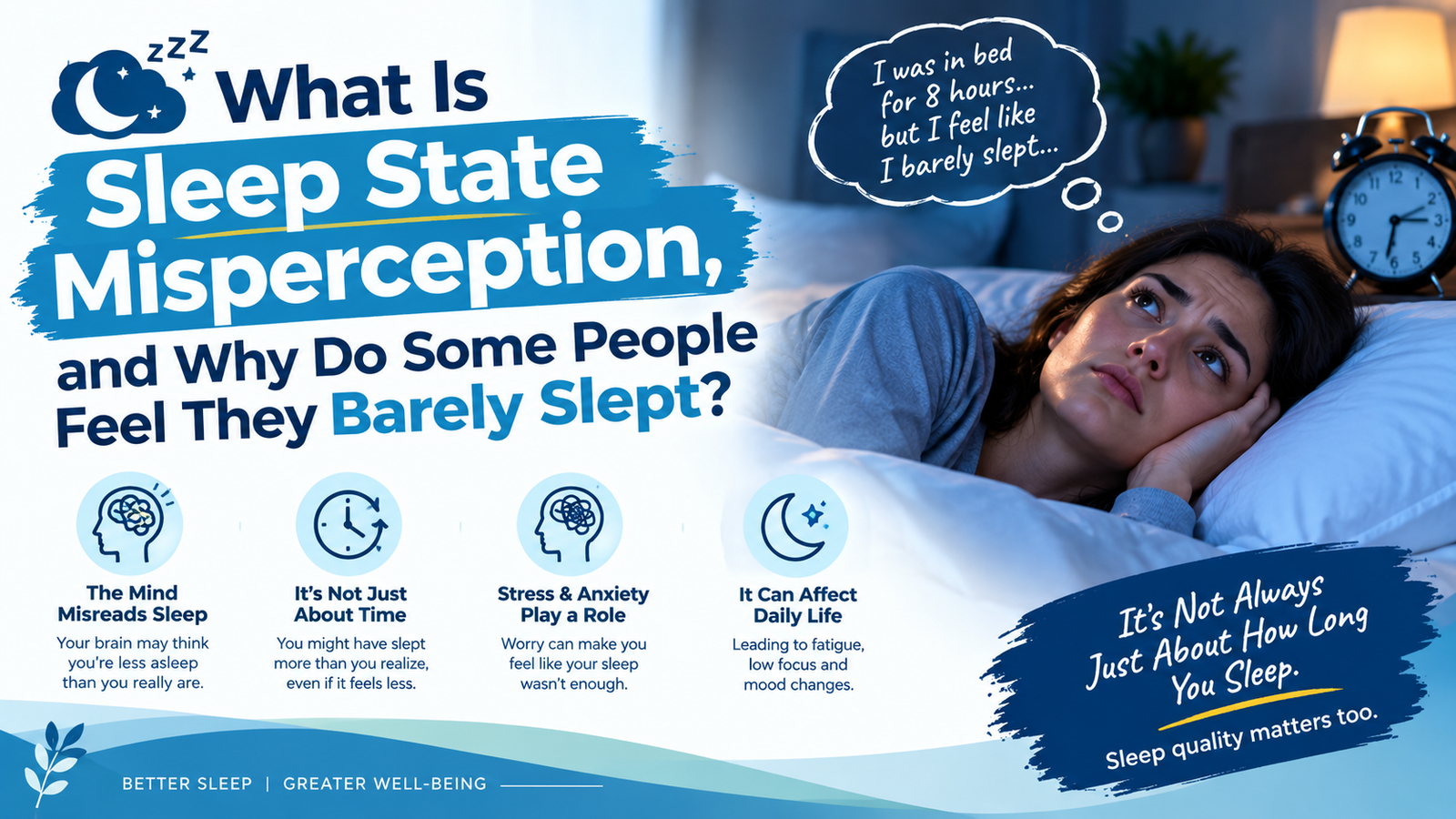
Have you ever spent the night feeling as though you were awake for hours, only to wonder whether you actually slept more than you remember? You might recall lying in bed, noticing every sound, thinking about the next day, and repeatedly checking whether you had finally fallen asleep.
This experience may be related to sleep state misperception, sometimes called paradoxical insomnia. It describes a mismatch between how much sleep someone believes they obtained and the amount of sleep measured objectively. Some people feel they were awake for most of the night even when sleep monitoring suggests they slept considerably longer than they perceived.
This does not mean their experience is imaginary. Feeling unable to sleep can be genuinely distressing, even when a person's perception of their sleep differs from objective measurements.
Understanding sleep state misperception can help explain why some people feel they barely slept, why bedtime becomes frustrating, and when professional assessment may be helpful. This guide explores the possible causes, symptoms, assessment methods, and practical strategies that may help.
For additional health information, visit JustinMedz.
What Is Sleep State Misperception?
Sleep state misperception refers to a situation in which someone significantly underestimates how much they sleep or perceives periods of sleep as wakefulness. The term paradoxical insomnia is also used for this experience.
For example, someone might believe they slept for only two hours because they remember lying awake for most of the night. However, a clinical assessment may suggest that they obtained considerably more sleep than they realized.
The difference between perceived and measured sleep varies from person to person. It does not necessarily mean someone is sleeping perfectly, nor does it rule out another sleep disorder.
The Cleveland Clinic's overview of paradoxical insomnia explains how people may feel as though they barely slept despite evidence that they obtained more sleep than they perceived.
It is also important to distinguish sleep state misperception from occasional sleeplessness. Many people sometimes misjudge how long they slept. A persistent, distressing pattern deserves closer attention, particularly when it affects daytime functioning.
Why Do Some People Feel They Barely Slept?
There is no single explanation for every case of sleep state misperception. Researchers continue to investigate why perceived sleep can differ from objectively measured sleep. Several factors may contribute.
1. Light sleep can feel like wakefulness
Sleep is not one continuous state of complete unconsciousness. It consists of different stages, and the brain continues processing some information during sleep.
During lighter sleep, a person may remain responsive to certain environmental sounds or experience brief awakenings that they remember afterward. When these experiences happen repeatedly, the night may feel fragmented.
Someone might remember hearing a car outside, noticing a change in room temperature, or becoming aware of movement in the house. These memories can create the impression that they were awake much longer than they actually were.
However, not every instance of light sleep indicates sleep state misperception. Frequent awakenings can also reflect a genuine sleep problem that deserves assessment.
2. Brief awakenings can distort your memory of the night
People do not necessarily remember every transition between wakefulness and sleep.
If you wake briefly several times during the night, you may remember those moments more clearly than the periods of sleep between them. When morning arrives, your recollection may emphasize the awakenings rather than the sleep itself.
Imagine waking at 1 a.m., 3 a.m., and 5 a.m. You might remember each episode and conclude that you barely slept. However, those moments alone cannot tell you how much sleep occurred between awakenings.
Repeatedly reconstructing the night in your mind may make the experience feel even more confusing.
3. Paying close attention to sleep can make wakefulness feel more prominent
Some people become highly focused on whether they are sleeping. They monitor their breathing, notice every sound, check the clock, and repeatedly ask themselves whether they feel sleepy.
This constant attention can make the experience of being awake more noticeable.
For instance, someone might think, "I can still hear everything, so I must be awake." But awareness of some sounds does not, by itself, establish whether someone is fully awake or asleep.
This pattern can overlap with sleep effort, when trying harder to fall asleep creates additional pressure. Reducing excessive monitoring may help some people approach bedtime with less frustration.
4. Worry about sleep can reinforce the experience
A difficult night can make you worry about the next one. You may begin going to bed with the expectation that you will struggle again.
During the night, you might calculate how many hours remain before your alarm or worry about how tired you will feel the following day. When morning arrives, you may review the night repeatedly, searching for evidence that you did not sleep enough.
This cycle can increase distress and make sleep feel like a performance that must be evaluated.
If persistent worry is affecting your sleep, a healthcare professional can help assess the factors involved. Sleep state misperception is not necessarily caused by anxiety, and other explanations may need to be considered.
5. Other sleep or health conditions may be involved
Sleep state misperception can occur alongside other conditions. Not every report of barely sleeping is explained by a difference between perceived and measured sleep.
Potential contributors to poor or disrupted sleep include:
Obstructive sleep apnea, which can interrupt breathing during sleep.
Restless legs symptoms or repeated limb movements.
Pain or other physical discomfort.
Certain medications or substances.
Anxiety, depression, or trauma-related symptoms.
Irregular sleep schedules or circadian rhythm disruptions.
These conditions can affect actual sleep, how sleep feels, or both. A clinician can help distinguish among possible explanations.
What Does Sleep State Misperception Feel Like?
The experience differs between individuals, but some people describe patterns such as:
Feeling aware of their surroundings for most of the night.
Believing they remained awake for hours despite having obtained some sleep.
Remembering repeated periods of wakefulness more clearly than periods of sleep.
Feeling frustrated when their recollection does not match sleep-monitoring results.
Worrying that their sleep is inadequate even when objective measurements suggest they slept longer than they thought.
Becoming increasingly preoccupied with how much sleep they are getting.
Daytime effects vary. Some people report relatively little daytime impairment, while others experience fatigue, distress, or difficulty functioning.
If you regularly wake feeling unrefreshed, struggle to concentrate, or experience significant daytime sleepiness, do not assume that sleep misperception explains everything. Other sleep disorders and medical conditions may need to be considered.
Sleep State Misperception vs. Insomnia: What Is the Difference?
These experiences can overlap, but they are not identical.
This distinction is not always straightforward. People with insomnia can also underestimate their sleep duration, and the categories should not be treated as mutually exclusive in every case.
The Sleep Foundation's explanation of paradoxical insomnia discusses the mismatch between perceived and measured sleep and the challenges involved in understanding it.
How Is Sleep State Misperception Diagnosed?
There is no simple home test that can reliably confirm sleep state misperception. Assessment usually begins with a conversation about sleep habits, symptoms, health history, and daytime functioning.
1. Review your sleep history
A healthcare professional may ask questions such as:
How long do you believe it takes you to fall asleep?
How often do you wake during the night?
How rested do you feel in the morning?
Do you experience daytime sleepiness or concentration difficulties?
Do you snore, gasp during sleep, or experience uncomfortable leg sensations?
Have your sleep habits or medications changed recently?
These details help identify whether the problem might involve insomnia, another sleep disorder, a medical condition, or a combination of factors.
2. Keep a sleep diary
A sleep diary records your estimated bedtime, time spent trying to sleep, awakenings, wake-up time, naps, and daytime symptoms.
The purpose is not to monitor yourself obsessively or prove that you are sleeping correctly. It is to help identify patterns over time.
If tracking makes you increasingly anxious, ask your healthcare professional how to keep a record in a way that is useful without intensifying sleep-related worry.
3. Consider objective sleep monitoring when appropriate
A clinician may recommend actigraphy, which uses a wearable device to estimate sleep and wake patterns over time. In selected cases, an overnight sleep study, known as polysomnography, may be appropriate.
However, an overnight sleep study is not routinely necessary for every person with insomnia. It may be recommended when another sleep disorder is suspected, the diagnosis is uncertain, or treatment has not been effective.
The American Academy of Sleep Medicine's practice parameters for polysomnography explain circumstances in which sleep studies may be useful.
The aim of assessment is to understand what is happening, not to dismiss someone's experience because a device records more sleep than they expected.
What Can Help When You Feel You Barely Slept?
The most appropriate approach depends on whether you have sleep state misperception, insomnia, another sleep disorder, or overlapping concerns. The following strategies may help reduce distress while you seek appropriate guidance.
1. Avoid repeatedly checking the clock
Looking at the time repeatedly can encourage mental calculations about how much sleep remains possible.
Try turning your clock away from the bed and keeping your phone out of reach. You do not need to know the exact minute you fall asleep.
If you wake during the night, focus on becoming comfortable rather than evaluating how much time you have lost.
2. Avoid assuming that every remembered awakening lasted a long time
A memory of being awake does not necessarily tell you how long that period lasted or how much you slept between awakenings.
Instead of concluding, "I was awake all night," consider a more neutral statement: "I remember several periods of wakefulness, but I cannot accurately determine my total sleep from memory alone."
This does not mean dismissing your symptoms. It simply acknowledges that remembering a night and measuring sleep are different things.
3. Keep a consistent sleep-wake routine
Try to wake up at a reasonably consistent time and maintain a routine that allows enough opportunity for sleep. Daytime activity and natural light may also help support your sleep-wake rhythm.
Avoid repeatedly moving bedtime earlier to compensate for a night that felt poor. Spending excessive time in bed while awake can sometimes reinforce frustration.
For persistent insomnia, ask a healthcare professional whether a structured approach such as cognitive behavioral therapy for insomnia (CBT-I) may help.
4. Reduce the pressure to achieve perfect sleep
Sleep is not a performance, and one difficult night does not determine how the next night will go.
Try not to judge your entire day by how well you believe you slept. If you feel tired, adjust your activities sensibly and avoid driving when dangerously sleepy.
If sleep concerns are becoming a persistent source of distress, consider professional support rather than continually trying new techniques on your own.
5. Ask about cognitive behavioral therapy for insomnia
CBT-I is a structured treatment for chronic insomnia. It can address unhelpful beliefs about sleep, behaviors that reinforce wakefulness in bed, and anxiety associated with sleeplessness.
It is not simply a set of general sleep hygiene recommendations. A trained clinician can tailor treatment to your circumstances and assess whether another condition needs attention first.
You can read the American Academy of Sleep Medicine's clinical practice guideline for behavioral and psychological treatments of chronic insomnia for more information.
6. Review medication questions with a professional
Do not start sleep medication, increase a dose, or combine sedating products simply because you believe you have slept very little.
Medication decisions depend on the cause of the sleep difficulty, your medical history, other medicines, and the potential risks and benefits.
If you are reviewing general medication information, JustinMedz has an Ambien medication category, along with product information for Ambien 5mg and Ambien 10mg. These pages are for product information and are not recommendations to use these medicines for sleep state misperception. A qualified healthcare professional should determine whether medication is appropriate.
Anxiety-related medicines are not interchangeable with insomnia treatments. For general medication reference, see the Lexapro medication category and the lorazepam medication category. These medicines have different uses and risks and should not be started, stopped, or combined without professional guidance.
Other medicines may also affect sleep or daytime alertness. The gabapentin medication category is another product-information resource, but gabapentin is not a general treatment for sleep state misperception. Ask your clinician or pharmacist whether any medicine you take could be affecting your sleep.
When Should You Seek Professional Help?
Consider speaking with a healthcare professional if you frequently feel that you barely sleep, regularly wake unrefreshed, or experience sleep difficulties that interfere with daily life.
Seek assessment sooner if you experience:
Severe daytime sleepiness that affects safety.
Loud snoring, choking, or gasping during sleep.
Repeated uncomfortable sensations or movements in your legs at night.
Persistent pain or other symptoms that interfere with sleep.
Significant changes in mood, concentration, or daily functioning.
A clinician can review your symptoms, identify possible contributors, and decide whether sleep monitoring or specialist assessment is appropriate.
If you are concerned that your sleep is inadequate, you do not need to determine the cause alone. Your experience deserves to be taken seriously, even when the amount of sleep you remember differs from what objective measurements suggest.
Frequently Asked Questions
Is sleep state misperception a real condition?
Yes. The term describes a recognized sleep-related experience in which perceived sleep duration differs from objectively measured sleep. The distress can be real even when a person has slept more than they believe.
Can you feel awake while actually sleeping?
Some people experience periods of sleep as though they were awake, particularly when sleep is light or fragmented. However, awareness of sounds or sensations alone cannot establish whether someone is asleep or awake.
Does sleep state misperception mean I am getting enough sleep?
Not necessarily. Some people obtain more sleep than they realize, while others have genuine sleep disruption or another sleep disorder. A clinician can help interpret your symptoms and determine whether further assessment is needed.
Can anxiety make sleep state misperception worse?
Anxiety and sleep-related worry may contribute to distress and increased monitoring of wakefulness. However, anxiety is not the only possible explanation, and other sleep or medical conditions may need to be considered.
Do I need a sleep study to diagnose sleep state misperception?
Not everyone needs a sleep study. Assessment generally starts with a detailed sleep and health history. A clinician may recommend objective monitoring when the diagnosis is uncertain or another sleep disorder is suspected.
Can sleep state misperception be treated?
Management depends on the individual findings and any associated conditions. Education about sleep, reducing sleep-related worry, and behavioral treatment may help. If chronic insomnia is also present, CBT-I may be recommended.
Is sleep state misperception the same as REM sleep?
No. REM sleep is a normal stage of sleep associated with vivid dreaming and distinctive brain activity. Sleep state misperception describes a mismatch between perceived and measured sleep duration.
When should I worry about feeling like I barely slept?
Seek professional advice if the experience is persistent, causes significant distress, or affects daytime functioning. Also seek assessment if you have symptoms such as loud snoring, gasping during sleep, or severe daytime sleepiness.
Conclusion
Sleep state misperception can be confusing because the experience of being awake may feel convincing even when objective measurements suggest that more sleep occurred than you remember.
This does not mean your concerns are imaginary. It means perceived sleep and measured sleep do not always match perfectly. Light sleep, remembered awakenings, attention to nighttime sensations, and worry about sleep may all contribute, although the explanation differs between individuals.
Rather than trying to determine your total sleep from memory alone, focus on consistent routines, reducing clock-watching, and seeking professional guidance when the problem persists. If another sleep disorder or medical condition is contributing, identifying it is an important part of getting appropriate care.
For additional health information, visit JustinMedz. Persistent sleep problems deserve a careful assessment, not dismissal or self-diagnosis.

Start Web Audio Call
Enter your details to launch our secure web Audio call room instantly!